Lecture time: 7 minutes
Tocopherols: little-known, and yet essential
It is actually more accurate to speak of tocopherols in the plural. They form a family of closely related lipid compounds with a wide range of properties.
From protection against oxidation to the stabilization of cell membranes, and from technological functionality to their essential role as a source of vitamin E, tocopherols each make a valuable contribution to our diet.
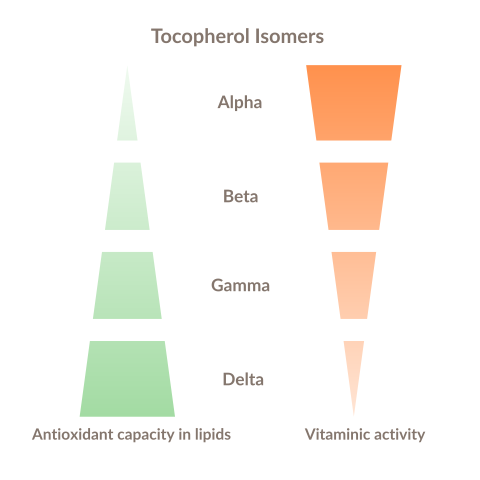
Tocopherols are lipid molecules produced exclusively by plants and are mainly found in vegetable oils. They belong to a family of 4 isomers (molecules with the same chemical composition but different structures), known as alpha, beta, gamma, and delta.
They differ from one another in the number of methyl groups attached to the molecule, but they all share the same function: protecting their surrounding environment from oxidation by oxidizing themselves first.
Each oil, depending on its fatty acid composition, contains various proportions of the four isomers. The oils that contain the most unsaturated fatty acids are more fragile and can oxidize rapidly. Fortunately, they are also the best protected: they naturally contain higher levels of tocopherols with the strongest antioxidant activity.
A vitamin is a substance that the body needs in very small amounts to function properly, but that it can’t produce in sufficient quantities on its own.
Identified in 1922 by Dr. Evans and Dr. Bishop, vitamin E helps protect cells from oxidation.
Vitamin E helps to:
Our bodies can’t produce vitamin E, so it must be consumed regularly through the diet.
Numerous scientific studies have shown that a deficiency in vitamin E can lead to infertility, fetal malformations, and neuromuscular and retinal disorders.
According to a European health claim:
« Vitamin E contributes to the protection of cells from oxidative stress »
The concept of vitamin E refers to a specific biological activity: protecting cells from oxidation. This activity, measured in International Units (IU), is linked to the alpha isomer, and more specifically to its natural form known as D-alpha tocopherol (now referred to as RRR-alpha tocopherol).
Among the four tocopherol isomers, D-alpha tocopherol is the one that carries biological activity, as it is easily absorbed in the intestine and efficiently delivered to cells via specific transport proteins. However, despite its essential biological role, it proves to be a relatively weak technical antioxidant in oils.
On the contrary, the other isomers, beta, gamma, and delta, exhibit little to no vitamin activity but are highly effective antioxidants.
Some vegetable oils are naturally rich in D-alpha tocopherol and are therefore considered good sources of vitamin E. This is the case for sunflower oil, and to a lesser extent, olive oil. The stability of these oils depends largely on their fatty acid composition, which does not make them particularly prone to oxidation, as well as on the presence of the other isomers (beta, gamma, and delta). Even in smaller amounts, these isomers act as powerful antioxidants within the oil.
As a result, these oils retain all their properties while offering genuine nutritional value: D-alpha tocopherol contributes vitamin E activity, while the other isomers help protect the oil itself.

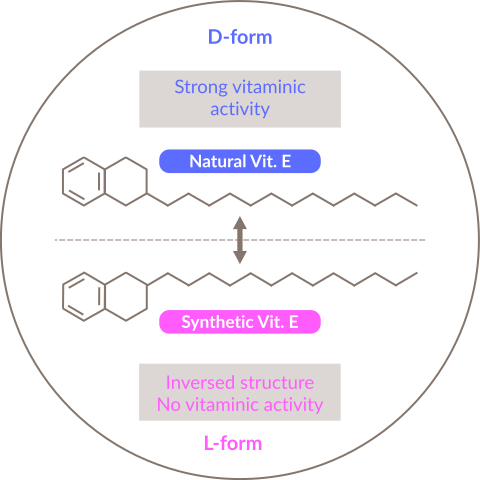
The tocopherols present in vegetable oils have a three-dimensional shape characteristic of their natural origin, called the D-form. Nature only synthesizes isomers with this specific form, which is the only one recognized and used by our body.
Chemical synthesis produces tocopherols that are almost identical to those produced by plants. However, this process creates a mixture of the D and L isomers. The L-form being a mirror image of the D-form. L isomers are not bioavailable; they are not recognized by the organism. Synthetic alpha-tocopherol thus have a lower vitaminic activity.
The diversity of tocopherols illustrates the complexity of the plant world from which they originate. This diversity also means that selection criteria can be applied depending on the intended use.
A natural origin guarantees that they all have a D shape, which is recognized by our organism and active in our cells. In this context, D-alpha tocopherol is the best choice for providing active vitamin E. For example, tocopherols extracted from sunflower oil consist of nearly 90% D-alpha tocopherol.
On the other hand, to provide maximum protection against oxidation in a product in order to prevent its degradation, beta, gamma, and delta isomers will be the most effective. This is particularly the case in soybean oil, in which they represent 80% of the tocopherols present.
Tocopherols occur naturally in vegetable oils. They are essential allies not only for our cells in the form of vitamin E, but also for everyday products, protecting them from oxidation.
Their diversity allows them to be used in a wide range of applications, provided that the most suitable tocopherols are carefully selected from the best available sources. This is an exciting challenge, as tocopherols can do almost anything.
Warning: this article is for informational purposes only and does not replace the advice of a healthcare professional.