PHOSPHOLIPIDS: ROLE, SOURCES AND BENEFITS

icon timerLecture time: 10 minutes

Summary

Fats are well known, but phospholipids remain largely overlooked, even though they are essential for our bodies. Present in every cell, they help maintain cell structure and assist in the transport of fats throughout the body. They play an important role in digestion and the functioning of certain key organs. This article will help you understand what phospholipids are, what they do, their benefits, and, most importantly, where to find them in foods and how they can be useful in dietary supplements.

What are phospholipids?

Phospholipids are fats present throughout the body and essential for the proper functioning of organs.

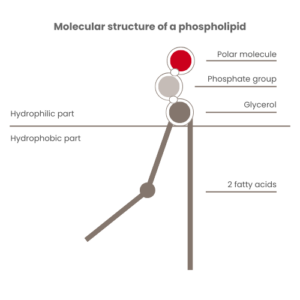
They are lipids made up of two parts:

  • a hydrophilic head composed of a phosphate group and a polar group (a group of molecules that attracts water due to the electric charges it contains)

  • a hydrophobic tail made up of two fatty acids

This is known as an amphiphilic structure.

Phospholipid molecular structure

Among the main phospholipids are phosphatidylcholine (PC), the most abundant in the body, phosphatidylethanolamine (PE), phosphatidylserine (PS) phosphatidylinositol (PI)

Dietary phospholipids are those obtained from food or supplements, whether of animal or plant origin. They allow the body to build and maintain cell membranes. Lecithins, for example, are natural mixtures of phospholipids rich in phosphoglycerides, used both in food products and dietary supplements.

Part of our daily intake of phospholipids comes from dietary sources, while another part comes from the endogenous synthesis of various phospholipids.

Functional Applications

Beyond their nutritional role, phospholipids are also used for their technical and functional properties. Thanks to their amphiphilic structure, they can stabilize mixtures of lipids and water, making them particularly effective as natural emulsifiers.

In the food industry, this ability is exploited to improve the texture, stability, and dispersion of fats in many products, such as chocolate, margarine, sauces, or liquid preparations.

You can find more information and details on these functional applications right here!

What is their role in the human body?


  • Essential Components of Cell Membranes

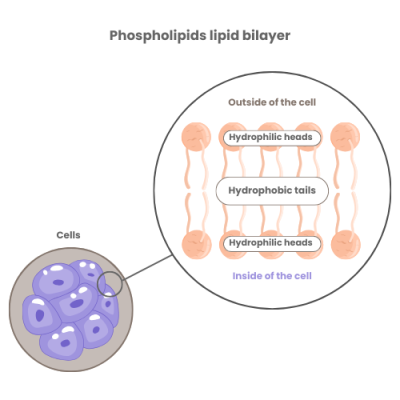
Phospholipids are the basic building blocks of cell membranes. To ensure stability, protection, and fluidity of the membranes, they are organized into a lipid bilayer. In this arrangement, the hydrophilic heads of the phospholipids face the aqueous environment both inside and outside the cell, while the hydrophobic tails face each other in the center, protected from water.

In this way, membranes isolate the intracellular space from the cell’s external environment, while allowing controlled exchanges between the two compartments.

Lipid bilayer
  • Role in Fat Digestion and Absorption

Phospholipids are part of bile salts. They facilitate the digestion of fats thanks to their emulsifying properties, helping to break down dietary lipids into small droplets that can mix with the aqueous environment of the digestive system. These droplets then form micelles, very small structures that enable the transport and absorption of fatty acids as well as fat-soluble vitamins A, D, E, and K


  • Role in Lipid Transport in the Blood

Phospholipids are part of lipoproteins, the particles that carry fats through the bloodstream. They help distribute lipids, particularly fatty acids, to the tissues that use them to produce energy or perform various biological functions.

  • Involvement in the Functioning of Certain Organs

    Phospholipids play specific roles depending on the organ.

    • In the liver: they contribute to the proper functioning and stability of hepatic cells. Phosphatidylcholine is the main source of choline for the liver. It plays a key role in fat metabolism, is essential for the formation and transport of lipoproteins that help remove fats from the liver, and helps maintain the integrity and stability of cell membranes in hepatic cells.

    • In the brain: they are involved in the structure of neurons and ensure the fluidity of nerve cell membranes. Phosphatidylcholine and phosphatidylserine provide the choline and serine needed by the brain to support communication between nerve cells.


     

Health benefits of phospholipids

Phospholipids are not only essential for the structure of our cells; they also provide numerous everyday health benefits.

Cognitive health improvement  

Phospholipids support the proper functioning of the brain. They help maintain the fluidity of nerve cell membranes and contribute to the support of memory, attention, and concentration. Consuming phospholipid-rich foods can therefore help support cognitive abilities on a daily basis.

Support of cardiovascular health 

Phospholipids contribute to the formation and stability of lipoproteins, which transport cholesterol in the blood, including HDL (“good” cholesterol) and LDL (“bad” cholesterol). An adequate intake can help maintain cardiovascular health and support the normal functioning of the heart and circulatory system.

Strengthening the Immune System and Overall Health

Phospholipids contribute to the health of cells and their membranes. Healthy cells are better able to respond to external challenges and support the immune system.

Other Health Benefits

  • Healthy fat digestion: they help with the absorption of fats and fat-soluble vitamins (A, D, E, K).

  • Overall health: by contributing to the renewal of cell membranes, they support overall well-being and help maintain energy levels.

Sources of Phospholipids in the Diet

Our metabolism allows cells to synthesize various phospholipids on their own. However, this does not mean that dietary intake is unimportant.

Why is dietary intake essential?

  • Because our endogenous production is not enough to meet our needs.

  • Because the quality of phospholipids partly depends on the fatty acids they contain (the better we eat, the higher the quality of our cell membranes).

  • Because certain situations can increase requirements.

  • Because some specific phospholipids (such as phosphatidylserine or phosphatidylcholine) are harder to produce in optimal amounts.

In certain situations, additional intake may be beneficial:

  • Strict vegan diets without soy or legumes

  • Very low-fat diets

  • Industrial diets low in nutrients

  • Increased needs related to age, physical activity, or stress

Sources de phospholipides V1

                                         Foods Rich in Phospholipids

  • Egg yolk: one of the richest foods in lecithin (a mixture of phospholipids), with a large proportion of phosphatidylcholine.
    Note: it’s thanks to the emulsifying properties of lecithins that mayonnaise gets its texture!

  • Nuts and seeds: soy and sunflower are the most commonly used plant sources for extracting lecithin and phospholipids.

  • Animal products: meats, offal, and fish, which contain phosphatidylserine and phosphatidylcholine.

  • Dairy products and fats: they contain fats surrounded by a thin layer of phospholipids.

The composition of phospholipids varies depending on the source: plant-based (soy, sunflower, rapeseed, etc.), animal (eggs, offal, milk), or marine.
This diversity concerns not only the type of phospholipids but also the fatty acids attached to them.

Phospholipid-Based Supplements

Nutritional use

When dietary intake is insufficient, for example in the case of a low-fat diet, an unbalanced diet, or certain specific needs (brain health, liver, metabolism, etc.), supplements can be considered. These often rely on phospholipids derived from soy, sunflower, egg, or sometimes marine sources, such as Lecimarine®, an extract rich in marine phospholipids. Naturally derived phospholipids are particularly valuable because they provide molecules identical to those found in the body, facilitating their use by the body and their integration into cell membranes.

However, as with any supplement, effectiveness strongly depends on quality, source, bioavailability, and the overall balance of the diet.

Conclusion

Phospholipids, although often invisible in the general discussion of nutrition, are essential molecules for the body: they play a role in cell structure, digestion and absorption of fats, metabolism, transport, brain function, and more.

A varied diet rich in phospholipids provides a healthy foundation to support cellular, brain, cardiovascular, digestive, and metabolic health. In certain cases, supplements or phospholipid-enriched ingredients can complement the diet (for example, for specific needs or restrictive diets), provided high-quality sources are chosen.

To support the production of phospholipid-based dietary supplements, Novastell offers complete ranges including phosphatidylcholine, phosphatidylserine, lecithins, and marine phospholipids, tailored to different formulation needs.

tournesols dans un champ

 Disclaimer: This article is for informational purposes only and does not replace the advice of a healthcare professional.

Linked products: