
 Temps de lecture : 8 minutes
Summary
It is often rightly pointed out that phospholipids are the basic building blocks of cell membranes. As a phospholipid, phosphatidylserine plays a part in the formation of these structures, but its role extends far beyond that. It is directly involved in cellular function by modulating the effects of receptors and ion channels embedded in the membranes.
Phosphatidylserine is essential for the functioning of nerve cells and brain performance. It protects receptors, enhances their sensitivity in the presence of neurotransmitters and safeguards them as we age.
All cell membranes consist of two layers of phospholipids.
The plasma membrane separates the intracellular environment – where the metabolic reactions that sustain cellular life take place – from the external environment. Without it, life would simply not be possible.
However, this membrane is not an impermeable barrier. Nutrients and signals must be able to enter the cell, whilst metabolic waste products must pass in the opposite direction into the external environment to reach other cells or be eliminated.
To this end, membrane channels and receptors are embedded in the membranes and can sometimes pass right through them.

The polar head of phosphatidylserine consists of the amino acid serine, from which it takes its name. Beyond its composition, phosphatidylserine differs from other phospholipids in terms of its distribution within the body and its localisation in membranes.
Phosphatidylserine is typically of animal origin. In humans, half of the body’s phosphatidylserine is concentrated in the brain, where it can account for up to 20 per cent of the phospholipids, earning it the nickname ‘the brain’s phospholipid’.
Beyond this specific distribution, phosphatidylserine is also localised in a way that is directly linked to its activity. It is concentrated on the inner surface of nerve cell membranes, facing the intracellular space.
It is organised around receptors and membrane channels, for which it provides a specific environment that underpins its physiological activity.
Scientific studies have shown that the affinity between a receptor and its neurotransmitter increases in the presence of Phosphatidylserine. Nerve signals are transmitted more easily and detected at lower levels.
Phosphatidylserine protects receptors, slowing down their decline as we age. In vitro trials on isolated membranes have shown that phosphatidylserine is capable of maintaining a receptor’s activity even in the presence of an inhibitor. This property is specific to it and is not found in other phospholipids.
These findings illustrate the effects of Phosphatidylserine on the brain, optimising the generation and transmission of nerve signals. It has been demonstrated in humans that dietary intake of phosphatidylserine is associated with an increase in brain activity as measured by an electroencephalogram.
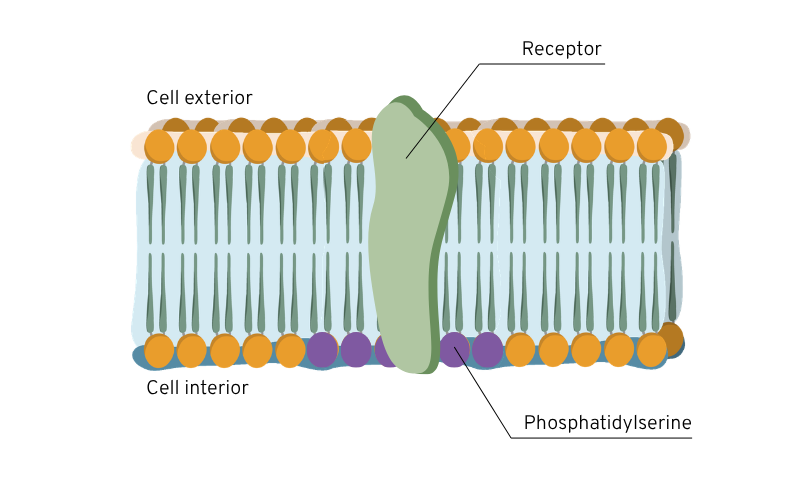
Phosphatidylserine is typically a phospholipid of animal origin, found in particularly high concentrations in the brain, which alone contains half of the body’s phosphatidylserine.
The brain’s phosphatidylserine content decreases with ageing, in parallel with a decline in brain function. It is possible to compensate for this decline through dietary intake and to slow down the deterioration of memory.

Our metabolism enables us to synthesise phosphatidylserine by modifying other phospholipids, but this endogenous synthesis is insufficient and dietary intake is essential.
As a result of changes in our dietary habits, our intake of phospholipids is steadily declining.
Even a slight reduction in the consumption of animal offal has a particularly marked impact on phosphatidylserine levels. Taking it as a dietary supplement can be an effective way of compensating for this decline.
Supplementation is all the more advisable as the brain’s phosphatidylserine content decreases with age, accompanying a decline in brain function. By the age of 70, the human brain has lost between 20 and 25 per cent of its PS content.
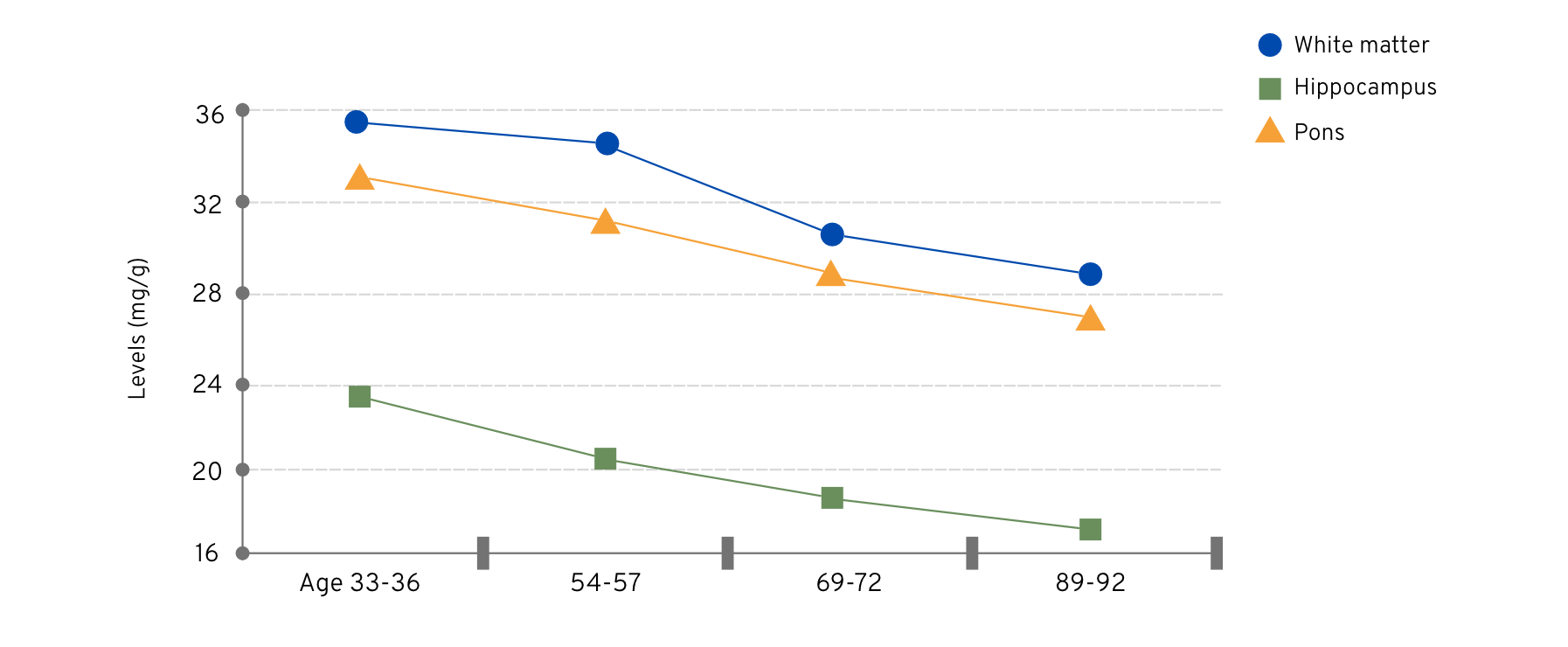
Phosphatidylserine is particularly concentrated in the hippocampus, the area of the brain involved in memory formation. It was its effect on memory that was the focus of the first scientific studies. These studies demonstrated that Phosphatidylserine supplementation helps to support memory in people with mild cognitive impairment. This positive effect is observed with a daily dose of 100 to 300 mg of Phosphatidylserine, but particularly when taken over a sufficiently long period, of at least 12 weeks. The aim of such supplementation is to restore Phosphatidylserine levels in nerve cell membranes and to re-establish optimal transmission of nerve signals.
This mechanism of action, based on enhancing interactions between receptors and neurotransmitters, may explain why the effectiveness of PS supplementation is highly dependent on the physiological state of the individuals receiving it.
Phosphatidylserine supplementation started very early in older adults has shown the greatest benefits. Late-stage supplementation in people with dementia, where the receptor-neurotransmitter interaction is already impaired, is less likely to be effective. And this is indeed what has been observed in numerous human trials.
As well as its effects on memory, Phosphatidylserine also has a positive effect on stress. This effect has been objectively measured using recognised biological markers such as cortisol and the hormone ACTH. It has also been assessed using questionnaires designed to highlight the effects on day-to-day well-being.
Finally, it has been shown that phosphatidylserine also has a beneficial effect on symptoms associated with attention deficit disorders, a condition known as ADHD. By improving concentration and reducing symptoms of hyperactivity, phosphatidylserine demonstrates its ability to regulate brain activity, rather than merely acting as a stimulant.
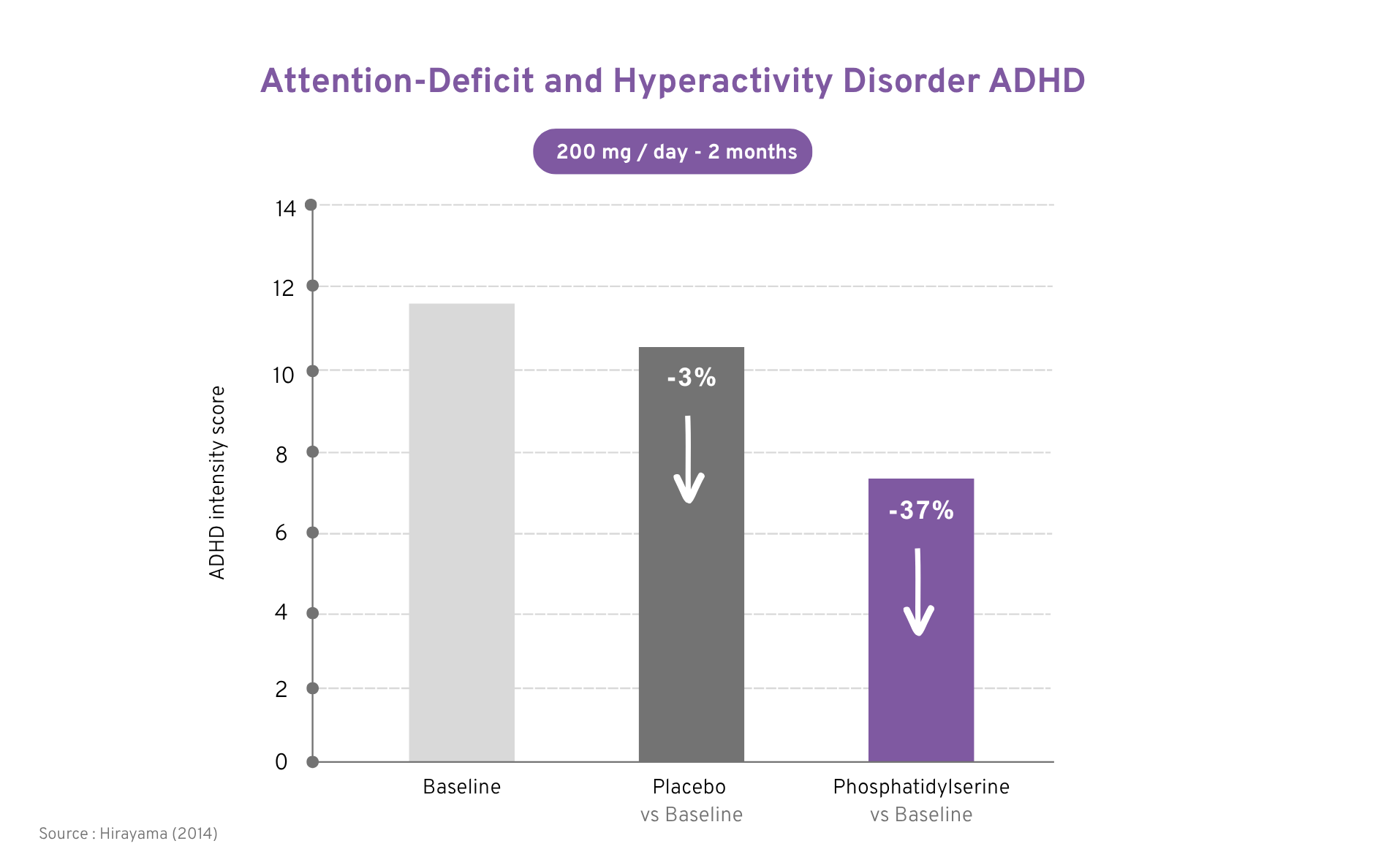
Phosphatidylserine is typically of animal origin, being particularly concentrated in the brain and offal of animals – all of which are dietary sources that are now largely neglected. For health reasons, it has also become impossible to offer ingredients derived from these sources.
There are few natural plant-based alternatives to these animal sources.
Plants do not represent a significant or effective dietary source of phosphatidylserine. Plant-based lecithins, although rich in phospholipids, contain only trace amounts of it.
Phosphatidylserine is obtained through the enzymatic modification of other phospholipids, primarily phosphatidylcholine, using plant-based lecithins as the starting material. It is therefore possible to obtain phosphatidylserine derived from soya or sunflower.
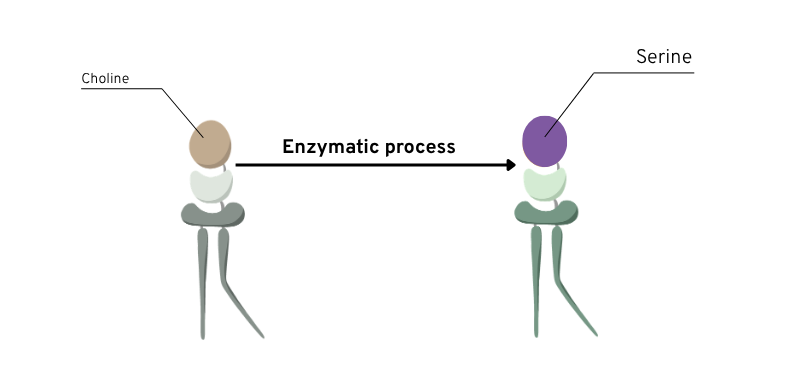
Phosphatidylserine is a perfect illustration of the unique mode of action of phospholipids, which act via specific pathways that are most often complementary to those of other active ingredients.
Phosphatidylserine is essential for nerve cells, as it plays an active role in the properties of their membranes, optimising the generation and transmission of nerve signals.
Receptors and neurotransmitters are essential for ensuring the brain functions properly. But they are not enough on their own. It is phosphatidylserine that optimises their action and enables the regulation of brain activity.
From memory and stress management to the regulation of hyperactivity, phosphatidylserine is indeed a vital component for our brain. It is essential to ensure an adequate intake, which relies largely on diet.

– Di Carlo R. et al Prog. Neuropsychopharmacol. Biol. Psychiatry 12 (1988) 915-926
– Rosadini G. et al Neuropsychobiology 24 (1990) 42-48
– Soderberg M. et al J. Neurochem. 54 n°2 (1990) 415-423
– Kato-Kataoka A. et al J. Clin. Biochem. Nutr. 47 (2010) 246-255
– Starks M.A. et al. J Int Soc Sports Nutr 5 (2008) 11-16
– Hirayama S. et al J. Hum. Nutr. Diet. 27 Suppl 2 (2014) 284-91
Produits liés :