Why are minor lipids so important for human metabolism?

icon timerReading time : 5 minutes

Summary

Phospholipids occupy a paradoxical position in human nutrition. Although they are present in foods at relatively low concentrations and are not routinely quantified in dietary monitoring systems, their absence from the diet could have significant physiological consequences.

Indeed, they play an essential role in human metabolism.


Historically, fats were primarily regarded as sources of energy or as culinary ingredients. They were also frequently implicated in the rising prevalence of lifestyle-associated diseases, including cardiovascular disease and diabetes.

However, this reductionist perspective has progressively evolved. It is now well established that lipids are involved in a wide range of physiological processes.


Despite this progress, certain lipid classes —present in very small dietary quantities and often referred to as “minor lipids” —remain comparatively under-characterized within nutritional surveillance frameworks.

Lipids misleadingly described as “minor”

The term lipids refers to a large and diverse family of nutrients. The most abundant are triglycerides, found in foods such as cooking oils. They are our main source of fatty acids, which provide energy to many of our organs.

But triglycerides are only part of the story. Our diet also contains many other lipids present in much smaller amounts. Because they occur in low concentrations and are rarely tracked in dietary monitoring, they are commonly referred to as “minor lipids.” Yet their physiological importance may be far from minor.

Phospholipids are one example. Our bodies can synthesize them, but not always in sufficient quantities to meet all functional needs. Diet therefore plays a complementary important role. Over the past century, however, eating habits have changed. The decline in consumption of offal and other phospholipid-rich foods has likely reduced our overall intake. While estimates suggest that average consumption was around 6 grams per day at the beginning of the 20th century, it may now be below 4 grams per day. This shift has largely gone unnoticed, because it has not been documented over the years.

In addition to this quantitative decline, there may also be qualitative changes. Certain phospholipids, such as phosphatidylserine —known to support brain function and neuronal communication—could be particularly affected.


These observations raise important questions :

– Should we reconsider the place of phospholipids in our diet? 

– And what role does supplementation have in such situations?

Phospholipids: the invisible molecules that keep us alive

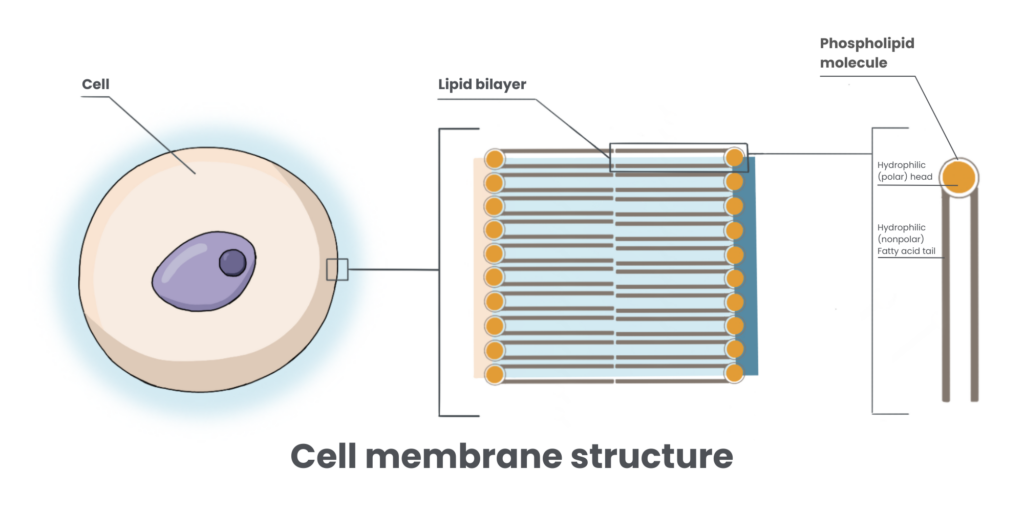
Without phospholipids, there would be no cell membranes. And without cell membranes, there would be no life.
Cell membranes define and protect each cell. They create a controlled internal environment where all the chemical reactions necessary for life take place. In doing so, they shield the cell’s interior from the outside world.
Cellular membrane
Yet membranes are not rigid walls. They are dynamic and highly organized structures. Proteins, receptors and channels are embedded within them, allowing constant exchanges with the environment.
This delicate balance depends directly on membrane composition. Phospholipids are not randomly distributed: each type occupies specific regions, depending on its structure and its interactions with surrounding proteins. 
Their precise arrangement determines membrane functionality. In short, the health of our cells—and therefore of our organs—depends on it.

Bioaccretion: a strategic reserve within our cells

Phospholipids, as an essential component of cell membrane, possess a remarkable property: they can spontaneously integrate into cell membranes and accumulate there. This phenomenon, known as bioaccretion, enables cells to store essential nutrients directly within their own structure. Among these nutrients are omega-3 fatty acids such as EPA and DHA, as well as choline. 

This mechanism is especially important in nerve cells. DHA, for example, contributes to membrane fluidity, which is crucial for efficient communication between neurons. In the liver, phosphatidylcholine acts as a reservoir of choline, a key molecule in hepatic metabolism.

Nutrients stored in membranes in the form of phospholipids are immediately accessible and form a readily available reserve that can be mobilized when needed.

Bioaccretion therefore represents a highly efficient strategy for maintaining cellular resilience and supporting the function of vital organs.

Fatty acids and phospholipids: why protection matters

Fatty acids obtained through diet or supplementation are essential throughout life. Certain stages—such as pregnancy, early development, and aging—are particularly sensitive to adequate supply.

Without phospholipids, the body cannot use certain nutrients as efficiently.

Triglycerides carry fatty acids throughout the body, where they are mainly used as energy. But some fatty acids, like DHA, are more selective—they need to reach specific organs to perform their crucial roles.

Phospholipids, naturally present in foods, do more than transport these fatty acids: they protect them. Carried in the blood within phospholipids, fatty acids are preserved and delivered directly to vital targets, such as the brain or retina.

In this way, phospholipids act as both guardians and guides, ensuring that essential fatty acids reach the organs that need them most. A quiet but vital ally for cellular health.

Brain nutrition is all about transport

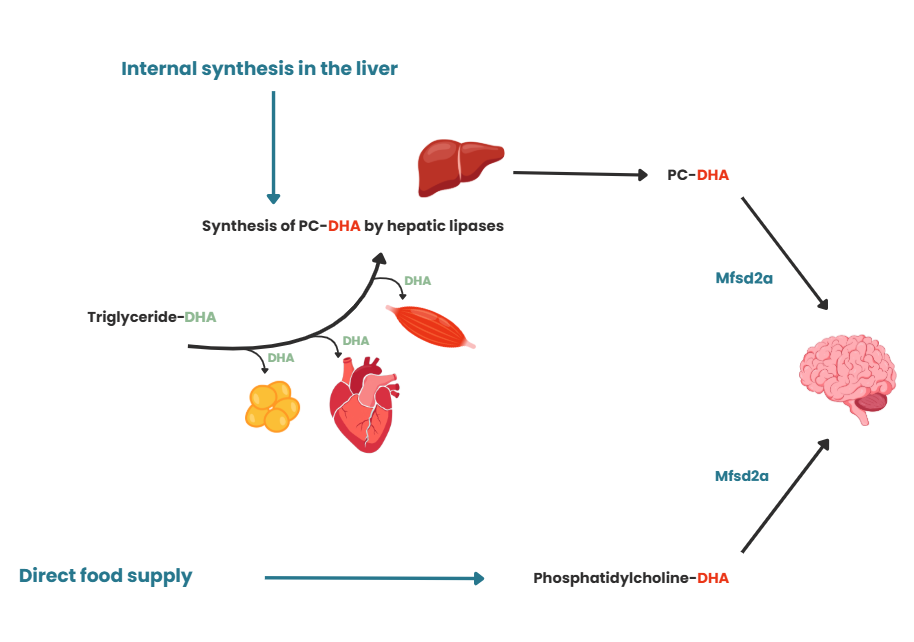
Feeding the brain is not just about what you eat, it’s about delivering nutrients to the right place. Phosphatidylcholine plays a central role in this process. Beyond supporting digestion and nutrient absorption, it protects choline in the intestine and preserves DHA in the blood, enabling both nutrients to cross the blood-brain barrier and reach neurons.

Supplementing with phosphatidylcholine increases free choline in the brain, which is essential for acetylcholine synthesis. It is the most effective form of choline transport to nerve cells.

Another advantage is its ability to bioaccumulate: by integrating into cell membranes, phosphatidylcholine keeps choline immediately available for brain function whenever it’s needed.

A major scientific breakthrough, discovered just over a decade ago, revealed a specific DHA transporter linked to phosphatidylcholine at the blood-brain barrier. This transporter actively and efficiently delivers DHA to nerve cells, overcoming the highly impermeable protective barrier.

Without adequate dietary phosphatidylcholine or sufficient DHA-phosphatidylcholine complexes produced by the liver, brain DHA levels can decline, potentially impairing cognitive performance.

Transport Mfsd2a

Minor lipids, major benefits

Macronutrients (lipids, proteins and carbohydrates) are closely monitored by health authorities. Essential nutrients, too, rightly receive careful attention to ensure adequate and regular dietary intake.

But there is a missing link: minor lipids, including phospholipids. Present in small amounts and rarely measured, these lipids are nonetheless essential. They do more than provide structure: they ensure that nutrients are absorbed, transported, and delivered to the organs that need them most. In short, these “minor” lipids play a major role in making both diet and supplementation truly effective.


⚠ Disclaimer: This article is for informational purposes only and does not replace the advice of a healthcare professional.
Related items: