 Reading time : 8 minutes
Summary
Choline is essential for the development and functioning of the nervous system. A daily intake of choline through the diet is vital, particularly during periods such as pregnancy, breastfeeding and the first few years of a newborn’s life.
Choline is available in various forms, either free or bound. Beyond the quantity, it is undoubtedly worth considering the form in which it is consumed.
Is the form obtained from food the same as that which nourishes the brain? Certainly not, and the importance of phosphatidylcholine deserves to be emphasised.
All cells require choline, and nerve cells in particular.
Choline is involved in vital reactions: methyl group transfer and what is known in the English-speaking world as ‘one-carbon metabolism’.
A choline deficiency during pregnancy has the same catastrophic consequences for foetal development as a deficiency in vitamin B9 or vitamin B12, as they are all involved in the same metabolic reactions. Tissue development may therefore remain incomplete, seriously compromising the health or even the survival of the newborn.
Choline is also an essential substrate for nerve cells in the synthesis of acetylcholine, a neurotransmitter that facilitates communication between neurons and triggers muscle contractions.
A continuous supply of choline to the nervous system is quite simply vital, both for its development and maintenance, and for its proper functioning.
Choline is naturally present in several forms in the diet, partly in free form, represented by choline salts, and in bound form.
Phosphatidylcholine accounts for the majority of the bound forms, but there are also other forms such as CDP-choline and alpha-glycerophosphorylcholine.
CDP-choline, also known as citicoline, is an intermediate in the body’s synthesis of phosphatidylcholine. Its synthesis requires energy, and it is not intended to accumulate in cells but to be used immediately.
Alpha-glycerophosphorylcholine, or α-GPC, is a breakdown product of phosphatidylcholine. Stripped of the two fatty acids present in phospholipids, α-GPC is characterised by being completely water-soluble.
α-GPC can be converted back into phosphatidylcholine by re-esterification of the two fatty acids.
Regardless of the form of choline used, it has been shown that dietary intake increases the levels of choline and acetylcholine in the brain.
But the journey from the gut to the brain is a long one, and fraught with obstacles! Once ingested, is it actually the same form of choline that crosses the blood-brain barrier? Nothing could be less certain.
The first hurdle is crossing the intestinal barrier, an essential step for any dietary nutrient.
Choline must then be transported via the bloodstream. It is distributed widely throughout the body before it can reach the brain. This stage can significantly affect the amount of choline that will actually be available to nerve cells. The liver, for example, is an organ that requires large amounts of free choline to maintain its metabolic functions.
Once again, the form in which choline is ingested has a bearing on its fate.
After absorption in the gut and transport via the bloodstream, there remains one final obstacle: the blood-brain barrier. This is the final, highly selective barrier that protects the brain against any unauthorised intrusion.
At each of these stages, the fate of choline will depend on the form in which it is present.
Free choline is actively absorbed via a specific transporter. This mode of transport requires energy and enables rapid uptake of choline. It carries a risk of transporter saturation if the amount of choline delivered to the intestine at any one time is too high.
In 2016, the EFSA (European Food Safety Authority) published nutritional recommendations for the daily intake of total choline for different population groups.
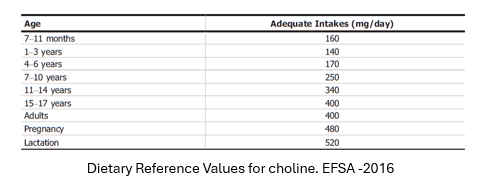
Although there is no recognised upper limit for the intestinal absorption of choline, it appears to be well absorbed up to a single intake of 300 to 400 mg of total choline.
However, it should be noted that this total amount, when obtained naturally from the diet, does not consist solely of free choline, which accounts for only around 40 per cent of it. Choline bound primarily to phosphatidylcholine constitutes the majority (Dumont E. – 2016).
The risk of choline transporter saturation in the intestine is therefore low when dietary intake consists of a mixture of the various available forms. However, the risk of saturation appears likely in the case of high, one-off supplementation exclusively in the form of free choline.
Phosphatidylcholine, a lipid molecule capable of freely crossing membranes, is absorbed passively – a mechanism that requires neither transporters nor energy; whilst slower, it is, above all, much more sustained. Consequently, the total amount of choline absorbed in bound form is estimated to be 12 times greater than that absorbed in free form (Hirsch M.J. et al. – 1978).
Another benefit of phosphatidylcholine is that it protects choline from being converted into TMAO, which is considered a risk factor for cardiovascular health.
With greater absorption and better protection, phosphatidylcholine is an essential form of choline in our diet.
What about the other two forms, citicoline and α-GPC?
The fate of citicoline is determined as soon as it is absorbed in the intestine (Roy P. et al. – 2022). It is broken down into choline on the one hand and cytidine on the other, which are then absorbed independently of one another. Citicoline is not found as such in the blood (Wurtman R.J. et al. – 2000).
Supplying choline in the form of citicoline is therefore equivalent to supplying free choline.
Once absorbed, CDP-choline cannot simply be reconstituted from these two fragments. It is a reactive molecule synthesised via a specific metabolic pathway for immediate use in the production of phosphatidylcholine.
Supplying citicholine through the diet is equivalent to supplying free choline.
L’ a-GPC est hydrosoluble et bien absorbée (Roy P. et al. – 2022). Mais là encore, elle n’est retrouvée qu’à l’état de traces au niveau sanguin. Son apport alimentaire provoque en revanche une augmentation rapide et importante de la choline libre circulante. Une part pourrait aussi être retrouvée sous forme de phosphocholine, autre précurseur de la phosphatidylcholine.
Dans les deux cas, et bien que leur efficacité pour l’apport de choline au cerveau ait été montrée, citicholine et a-GPC ne sont pas les formes de choline qui arriveront jusqu’à la barrière hémato-encéphalique.
Regardless of the oral formulation used, the blood transport stage therefore boils down to two forms: free choline and phosphatidylcholine.
Choline is widely distributed throughout the body. The liver is particularly dependent on this external supply and will draw on the majority of the available free choline.
However, the brain’s supply cannot be dependent on the needs of other organs, and nerve cells must be guaranteed a steady supply. It is phosphatidylcholine that ensures this.
The primary function of phosphatidylcholine is to protect the fraction of choline required by nerve cells and enable it to cross the blood-brain barrier.
To reach the brain, there is one final hurdle: crossing the blood-brain barrier, whose role is to act as a tight and selective screen before coming into contact with nerve tissue.
The transport of free choline is similar to that across the intestinal barrier: active transport with limited efficiency.
Once again, the most effective source of choline is phosphatidylcholine, which is actively taken up via a recently described transporter, the Mfsd2a transporter. It is this same transporter that enables DHA to be transported to nerve cells in the form of phosphatidylcholine, ready to be incorporated directly into cell membranes.
Phosphatidylcholine therefore fulfils several roles in brain nutrition: it protects nutrients during transport in the bloodstream – choline and DHA are inseparable in this process (Klatt K.C. et al. – 2022); it facilitates the active and efficient crossing of the blood-brain barrier; and, finally, it makes these nutrients available as and when needed by integrating into the membranes of nerve cells.
Our diet naturally provides us with choline in various forms, either free or bound.
Beyond the quantitative aspect, it is also important to consider the qualitative aspect and the ultimate target of choline intake.
As the brain is the body’s most protected organ, it is in the context of brain nutrition that this consideration takes on its full significance.
Phosphatidylcholine has been shown to be an essential component of choline intake. Whilst this can be effectively ensured in various ways, phosphatidylcholine is the form that preserves and delivers the portion of choline that the brain vitally needs to function properly.
Its role in transporting nutrients to nerve cells is not limited to choline; it also facilitates the transport of DHA. That is another story, which we will return to later.

– Dumont E. NUTRACOS 2 (2016) 7-9
To supply choline AND phosphatidylcholine for liver: it makes sense.
– Hirsch M.J. et al. Metabolism 27 n°8 (1978) 953-960
Relations between dietary choline or lecithin intake, serum choline levels, and various metabolic indices.
– Roy P. et al. Front. Cell. Neurosci. (2022) 16:988759. doi: 10.3389/fncel.2022.9887592022
Effects of choline containing phospholipids on the neurovascular unit: A review.
– Wurtman R.J. et al. Biochem. Pharmacol. 60 n°7 (2000) 989-992
Effect of oral CDP-choline on plasma choline and uridine levels in humans
– Klatt K.C. et al. Am. J. Clin. Nutr. 116 (2022) 820–832
Prenatal choline supplementation improves biomarkers of maternal docosahexaenoic acid (DHA) status among pregnant participants consuming supplemental DHA: a randomized controlled trial.