ALL ABOUT FATTY ACIDS

icon timerLecture time: 12 minutes

Summary

Fat is often said to be bad for health. However, what is generally overlooked is that fatty acids, the main components of fats, are essential to our bodies. As is often the case, it is all a matter of quality and balance.

In this article, we will explore what fatty acids really are, why they are essential to our bodies, and how to distinguish the “good” ones from the “less good” ones. We will also look at how they are classified into different families, where to find them in our diet, and their impact on our health. You will also discover how they function in the body, their main uses, the criteria to consider when choosing high-quality fatty acids, and finally, how to properly incorporate them into your diet.

Whether you are simply curious, passionate about nutrition, or a professional in the field, this article will provide answers to your questions.

What Is a “Fatty Acid”?

Fatty acids belong to the lipid family, more commonly referred to as “fats” in our diet. From a purely scientific point of view, a fatty acid is a chain of carbon atoms with an “acid” group at one end.

In the body, most fatty acids are found in the form of triglycerides (three fatty acids attached to a glycerol molecule), which is the form used to store energy. Fatty acids are also found in phospholipids, molecules that make up the membranes of our cells.

What are they used for?

  • Energy storage: fatty acids are used to store energy (calories) when the body has more than it needs. After being converted into fatty acids, this highly concentrated energy surplus is stored in adipose tissue, or fat reserves. When the body needs energy, between meals or during physical activity, it can draw on these reserves: triglycerides are broken down again into free fatty acids and glycerol. Cells then use these fatty acids to produce energy available to the body.
  • Structural role: fatty acids are found in the composition of phospholipids, the main components of cell membranes. They help ensure that the membrane is not too rigid, remains stable, and can selectively control what enters the cell and what does not.
  • Body regulation: depending on their type, some fatty acids serve as raw material for the production of so-called “messenger” molecules. These molecules help regulate important bodily functions such as inflammation, blood clotting, or the activity of certain genes.

Families of Fatty Acids

Fatty acids can be classified according to two main criteria, the structure of the molecule, specifically the number of double bonds in their chemical structure, which act like joints in the chain, and whether or not they require an external supply.

According to their structure:

  • Saturated, they have no carbon–carbon double bonds. This gives them a rigid structure, which explains why they are often solid at room temperature.
    • Examples include palmitic acid, found notably in coconut oil and butter.
      The body can produce them, and excessive intake of saturated fatty acids can lead to cholesterol-related issues.
  • Monounsaturated, they contain a single double bond. They are more flexible than saturated fatty acids and are therefore liquid at room temperature.
    • Example, oleic acid, an omega-9 fatty acid, is abundant in olive oil, which is one of the reasons it remains liquid at room temperature.
  • Polyunsaturated, they contain several double bonds. These fatty acids are more flexible than others and remain liquid even at low temperatures.
    This group includes omega-3 and omega-6 fatty acids, which allow oils rich in them to stay liquid even when refrigerated.
  • Trans, these are modified unsaturated fatty acids, often produced through industrial processes, in which the geometric configuration is altered. This deformation changes the way they behave in the body.

According to physiological need:

  • Essential, these are fatty acids that the body cannot synthesize, or not in sufficient amounts, and therefore must be provided through diet or dietary supplements.
  • Omega-6, linoleic acid is the main omega-6 fatty acid that the body must obtain from food, as it cannot produce it on its own.
  • Omega-3, alpha-linolenic acid (ALA) is the main essential omega-3 fatty acid. The body can convert it into eicosapentaenoic acid (EPA) and docosahexaenoic acid (DHA), two omega-3 fatty acids that are very important for heart and brain health. However, this conversion is not efficient enough, especially for producing DHA. This is why it can be useful to consume them directly through certain foods such as fatty fish or algae oils, or to provide them through supplements such as Lecimarine®.
  • Non-essential, the body can normally produce them, but in certain situations such as growth, illness, or aging, it may not produce sufficient amounts.

Where can we found them in our diet?

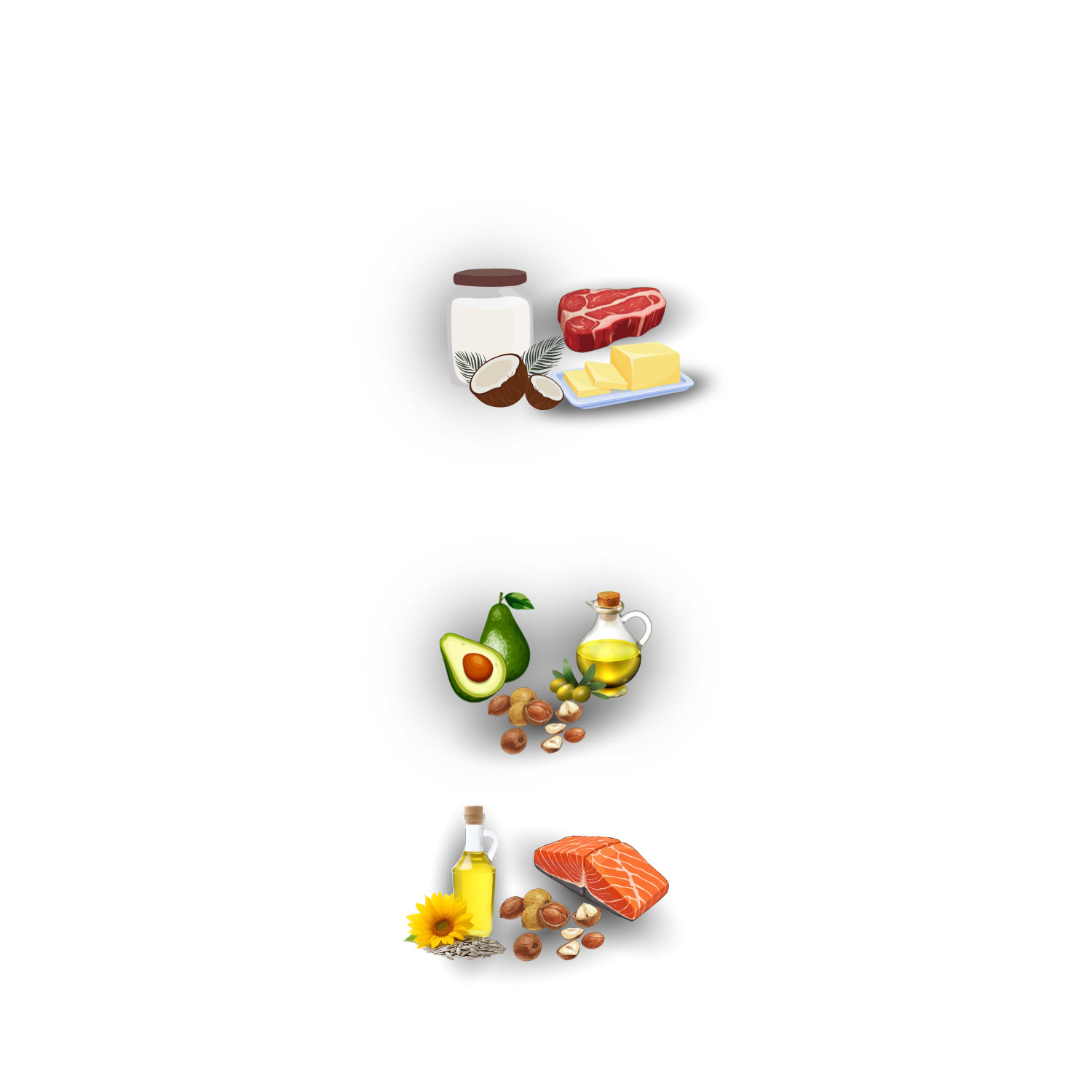
  • Saturated fatty acids:
    • fatty meats,
    • butter,
    • cream,
    • certain dairy products,
    • coconut oil,
    • palm oil
  • Monounsaturated fatty acids, especially omega-9:
    • olive oil,
    • avocado,
    • nuts,
    • certain animal fats
  • Polyunsaturated fatty acids:
    • Omega-3, fatty fish such as salmon, mackerel, and sardines, vegetable oils like rapeseed, flaxseed, and walnut oil, as well as certain seeds.

    • Omega-6, sunflower oil, corn oil, soybean oil, nuts, and seeds.
Acides gras sources (3)

What are their impacts on our health?

  • Saturated fatty acids: when consumed in excess, some saturated fatty acids can promote the accumulation of deposits in the arteries. Over time, these deposits can thicken or block the arteries, increasing the risk of cardiovascular problems.
  • Monounsaturated fatty acids, mainly omega-9:  often beneficial and can help keep arteries flexible and improve cholesterol levels by increasing “good” cholesterol and reducing “bad” cholesterol.
  • Polyunsaturated fatty acids:
    • Omega-3, they are very important for the brain, vision, and the nervous system. Examples include EPA and DHA, two types of omega-3 fatty acids that play a protective role for the heart by reducing triglyceride levels and lowering blood pressure, and that also support brain health.
    • Omega-6, these are also essential. They are raw materials for building cell membranes and for producing molecules involved in inflammation and blood clotting. However, consuming too much omega-6 relative to omega-3 can lead to an imbalance. Both families, omega-3 and omega-6, are processed by the same enzymes before acting in the body, so an excess of omega-6 limits the conversion and therefore the action of omega-3. This imbalance is quite common, as most commercially available vegetable oils are rich in omega-6, while omega-3s are consumed less frequently.
  • Trans fatty acids, these should be limited or even completely avoided, as they increase the risk of cardiovascular disease. This type of fatty acid
      • increases “bad” cholesterol carried by LDL, which transport cholesterol from the liver to the cells,
      • reduces “good” cholesterol carried by HDL, which transport excess cholesterol back to the liver for elimination,
      • promotes inflammation.

Consuming trans fatty acids increases the risk of cardiovascular disease. The majority of trans fatty acids in the diet are of industrial origin, and national and international health authorities recommend consuming as little of them as possible.

How does the body use fatty acids?

  1. Digestion and absorption: When we eat fats, most of them are in the form of triglycerides. These triglycerides are broken down in the intestine (with fatty acids released
    from the glycerol), then absorbed into the bloodstream. Once in the blood, the body can either use them for energy or reassemble them into
    triglycerides for storage.
  2. Transport: Fatty acids cannot travel alone in the blood because they do not mix with water. They are carried through the body by lipoproteins (LDL & HDL, which also carry cholesterol, VLDL, etc.).
  3. Use in the body:
    • Energy production: Fatty acids can be oxidized in cells to produce adenosine triphosphate (ATP), the energy the body needs to function.
    • Membrane construction: Some fatty acids are used to make phospholipids, the main components of cell membranes, which maintain fluidity and protect cells.
    • Signaling molecules: Polyunsaturated fatty acids like omega-3 and omega-6 can be converted into eicosanoids, molecules that send signals to cells to regulate processes like inflammation, blood clotting, and blood vessel constriction.
    • Storage: Excess fatty acids can be reassembled into triglycerides and stored in fat tissue for later use.
  4. Regulation: Some fatty acids influence gene expression. They can activate proteins that control how fats are used by cells, whether for immediate energy, storage, or cholesterol production.

Main applications

  • Nutrition and diet: In our diet, fatty acids help guide our choices of fats. The goal is to vary sources and limit saturated fats, and especially trans fats. This means choosing oils and foods rich in “good fats” (omega-3s, monounsaturated fats) for a healthy diet.
  • Supplementation: Omega-3s (EPA/DHA) are often found in dietary supplements such as fish oil, algal oil, or Lecimarine®. These supplements are usually used for heart, brain, and eye health, and to help regulate inflammation.
  • Food industry: Fatty acids are added to the formulation of oils, margarines, and enriched products to improve nutritional quality and meet health guidelines.
  • Medical research: Fatty acids are studied for their effects on inflammation, metabolism, brain function, and chronic diseases (cardiovascular, metabolic, and neurodegenerative). Understanding their role in the body opens new possibilities for nutritional and therapeutic strategies.

Precautions : How to recognize high-quality fatty acids?

Key Points to Check

  • Purity: Make sure the oil is not oxidized, rancid, or contaminated. When an oil goes rancid, its taste and smell change, and its nutritional quality
    decreases.
  • Extraction Method: Oils can be produced in different ways. Cold-pressing is a gentle, heat-free method, while solvent extraction uses chemicals to extract more oil. This latter method can leave traces of solvents in the oil and make it more prone to oxidation.
  • Omega-3 to Omega-6 Ratio: Both omega-3 and omega-6 fatty acids are important, but most people consume too much omega-6 compared to
    omega-3. For edible oils, it’s best to maintain a good balance, with sufficient omega-3. This helps reduce inflammation and supports
    cardiovascular health.
  • Storage: Polyunsaturated fatty acids (like omega-3) are fragile. They oxidize quickly, lose their benefits, and can even become harmful. That’s
    why some oils should be kept away from light (sometimes in dark bottles), refrigerated after opening, and used quickly.

Contamination Risks

  • Extraction Solvents: Some vegetable oils (soy, canola, sunflower) are produced on a large scale and may be extracted with chemical solvents,
    the most common being hexane. Hexane dissolves lipids to extract more oil. Normally it’s removed during refining, but small traces can remain.
  • Heavy Metals & Pollutants: Marine products (fatty fish) can contain contaminants like mercury, PCBs (industrial chemical pollutants), and others. The French National Agency for Food Safety (ANSES) recommends varying fish species and limiting consumption of certain predatory fish (like tuna or shark).

Conclusion

Fatty acids are not a problem for our bodies. On the contrary, they are essential components of our diet and physiology: they help store energy, build
cell structures, and regulate many biological processes. However, not all fatty acids are equal. Some, like omega-3s, are very beneficial, while others
(trans fats or excessive saturated fats) can pose health risks. It is therefore important to consume quality fats in a balanced way and pay attention to
the origin of the products (extraction method, storage, contamination).


 Disclaimer: This article is for informational purposes only and does not replace the advice of a healthcare professional.

Acides gras sources 4

Linked products: